Artificial Intelligence is becoming increasingly advanced, influencing how people communicate, work, learn, and interact with technology. From virtual assistants and customer service chatbots to healthcare applications, AI systems are now designed to recognise and respond to human emotions. But an interesting question remains: Can AI actually understand what people feel, or can it only recognise emotional patterns?
Human emotions are complex. Happiness, sadness, anger, fear, excitement, and frustration can be expressed through facial expressions, words, voice patterns, and body language. AI can analyse these signals and make predictions about emotional states. However, understanding emotions involves more than identifying expressions. It also requires context, personal experiences, empathy, and social awareness.
1. How Does AI Recognise Human Emotions?
AI uses different technologies to identify patterns associated with human emotions.
Machine learning systems can be trained using large datasets containing facial images, voice recordings, written conversations, and other forms of information.
For example, an AI system may analyse facial movements, changes in voice tone, or word choices to estimate whether someone appears happy, frustrated, or upset.
Natural Language Processing (NLP) helps AI understand emotional language in written communication. It can identify positive, negative, or neutral expressions in messages and conversations.
However, these systems make predictions rather than directly experiencing emotions. Their accuracy can vary depending on cultural differences, individual behaviour, language, and context.
2. Can AI Understand Emotions Through Conversations?
Modern AI chatbots can analyse the language people use and respond according to the emotional tone of a conversation.
For example, if someone writes about a stressful situation, an AI assistant may recognise expressions of frustration and respond in a supportive manner.
It can also adjust its language to sound more encouraging, calm, or professional.
This capability is particularly useful in customer support, educational applications, and digital assistance.
However, AI does not necessarily understand the personal meaning behind every emotional statement. Sarcasm, humour, indirect communication, and complicated personal situations can be difficult to interpret correctly.
3. The Role of AI in Mental Health Support
AI-powered applications are increasingly being explored as tools for mental health support.
Some applications provide guided relaxation exercises, mood tracking, journaling features, and structured conversations.
For example, users may record their daily feelings and receive suggestions for managing everyday stress or developing healthier routines.
AI tools can also help people access general mental wellness information when professional support is not immediately available.
However, these applications should not replace qualified psychologists, psychiatrists, or other healthcare professionals.
AI cannot reliably diagnose every mental health condition or understand the full complexity of an individual’s personal circumstances.
4. How Businesses Are Using Emotional AI
Businesses are exploring emotion-related AI technologies to improve customer experiences.
For example, customer service systems may analyse written feedback to identify common complaints and customer satisfaction patterns.
Voice-based systems can also examine speech characteristics to estimate whether a caller sounds frustrated or dissatisfied.
Retail businesses may use customer feedback analysis to understand how people respond to products, advertisements, and services.
However, emotional analysis should be used carefully. Incorrect assumptions about a customer’s feelings can create poor experiences, while excessive monitoring may raise privacy concerns.
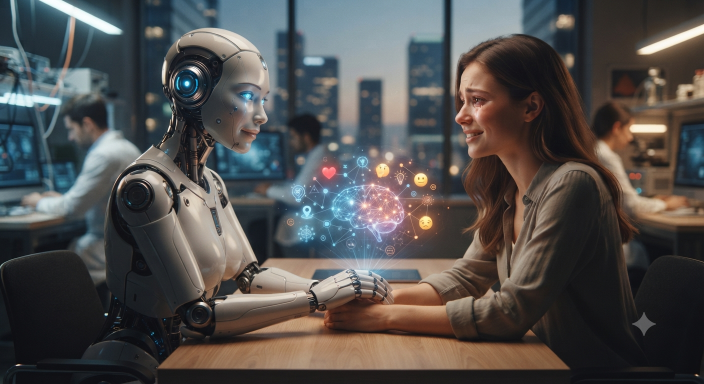
5. Can AI Show Empathy Like Humans?
Empathy involves recognising another person’s emotional experience and responding with understanding and care.
AI can generate supportive responses, acknowledge emotional language, and suggest possible solutions.
For instance, if someone discusses a difficult day, an AI assistant can respond with reassuring language and offer practical suggestions.
However, there is an important difference between expressing empathy and actually feeling it.
Human empathy develops through personal experiences, relationships, emotions, and social understanding. AI systems generate responses using learned patterns and computational processes.
They can imitate certain aspects of empathetic communication, but they do not experience human emotions in the way people do.
6. The Challenges of Teaching AI Emotional Intelligence
Developing emotionally aware AI systems comes with several challenges.
Cultural differences: Facial expressions and communication styles can vary between cultures. The same expression may have different meanings depending on the situation.
Privacy concerns: Emotional recognition technologies may collect sensitive information through voice recordings, images, and personal conversations.
Incorrect predictions: A person who appears angry may actually be tired, worried, or concentrating.
Algorithmic bias: AI systems trained on limited datasets may not accurately recognise emotional expressions across different populations.
Addressing these issues is essential for developing responsible emotional AI technologies.
7. The Future of AI and Emotional Intelligence
Future AI systems may become better at understanding conversational context, recognising emotional language, and adapting their communication styles.
In education, emotionally responsive learning assistants may help students when they feel confused or overwhelmed.
In customer service, AI may provide more personalised interactions by recognising frustration and directing customers towards appropriate support.
Healthcare applications may also use AI to assist professionals in analysing patient-reported information and identifying patterns that deserve further attention.
Nevertheless, transparency, privacy, and human oversight will remain important.
Conclusion
AI is becoming increasingly capable of recognising emotional patterns through language, facial expressions, and voice analysis. These developments are creating new opportunities in education, healthcare, customer service, and digital communication.
However, recognising an emotion is not the same as experiencing or understanding it as a human does. AI can simulate empathetic communication, but genuine human emotional experiences remain much more complex.
The future of emotional intelligence in technology will depend on combining useful AI capabilities with human judgement, responsible development, and respect for individual privacy.